
Cricket Scorecard Explained: A Beginner’s Guide
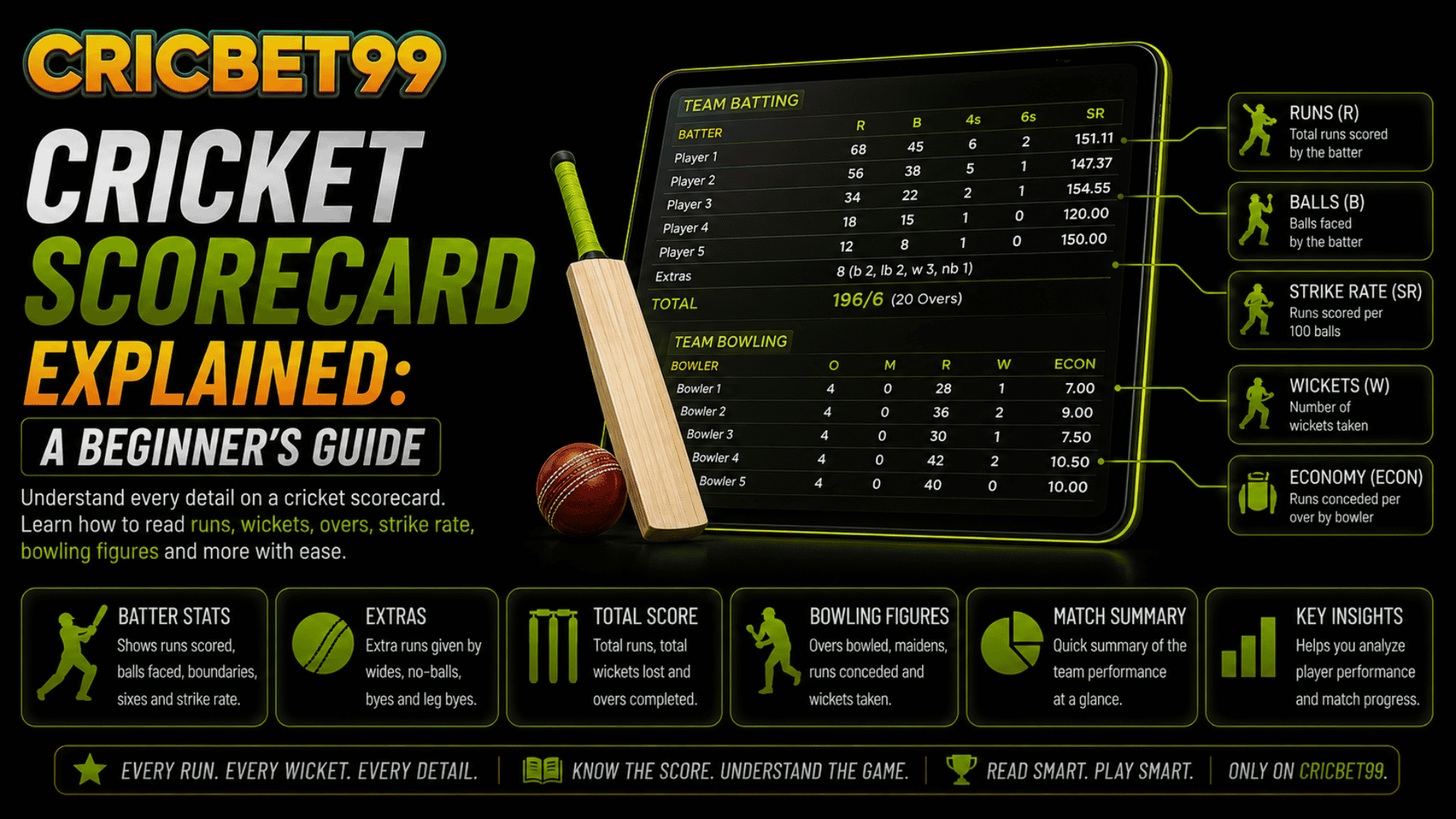
A cricket scorecard provides a comprehensive view of the events during an innings. Runs, wickets, overs, batsmen’s scores, bowling analysis, extras, and fall of wickets are included in the scorecard. Initially, the figures might look confusing, but with an understanding of the basic structure, it is very easy to read a scorecard. For example, the score of IND 258/10 (47.5) indicates that India scored 258 runs and lost all ten wickets in 47 overs and five legal balls.
Cricket scorecard explained
Cricket scorecard explained that one needs to understand the interrelations of different numbers. The team score shows the total outcome of the innings, and the batting score shows the individual performances, and the bowling score shows the performance of the opponents. For instance, when a batsman scores 75 runs in 60 balls, then one can see it through the batting scorecard that how many runs he scored by him and the duration for which he played.
How to read a cricket scorecard
Learning How to read a cricket scorecard becomes easier when you follow a fixed order. First, check the team’s total runs, wickets, and overs. Next, analyse the batting scorecard to know about the best performers along with their strike rate. Lastly, check the bowling performance sheet to know the wickets, runs conceded, maiden overs, and economy rate. Official Cricbet99 – This term can be used in an unbiased manner while talking about how a website or an online platform introduces itself.
Lastly, you need to check extras and Fall of Wickets. In this way, you will be able to find out the key events of an innings without getting stuck into the details of each figure.
Cricket scorecard terms
Familiarity with cricket scorecard terms is essential for novice players because virtually all scorecards employ abbreviations. R stands for runs, B stands for balls faced, 4s and 6s represent boundaries, and SR stands for strike rate. In bowling figures, O means overs, M means maiden overs, R means runs conceded, W means wickets, and Econ means economy rate. cricbet99 id provider — This phrase can be explained as a term people may use when referring to an online account or ID service connected with a cricket-related platform.
Dismissal terms such as bowled, caught, lbw, run out, and not out explain what happened to each batter.
Batting and bowling scorecard
A Batting and bowling scorecard lets you compare the performances of batters and bowlers during the same innings. Batting stats include runs, balls, fours, sixes, and strike rate, while bowling stats include overs, maidens, runs given, wickets taken, and economy rate. In this case, when a bowler is able to take three wickets for only 30 runs given, he will have shown good bowling stats. On the other hand, the batting stats will tell which players were able to score runs against such bowlers.
Cricket match statistics
Cricket match statistics provide useful information beyond the final score. They can show the highest individual score, most wickets, number of boundaries, best strike rate, economy rate, extras, and Fall of Wickets. These numbers help explain how a match developed. A team may have a strong total because several batters made useful contributions, while another team may depend heavily on one player. Looking at the statistics can reveal these details.
Cricket Scorecard and Team Total
The main Cricket Scorecard summary normally follows the format Runs/Wickets (Overs). If the score is 258/7 (50), the team has scored 258 runs and lost seven wickets after completing 50 overs. If the score is 258/10 (47.5), the team has been bowled out for 258 after 47 complete overs and five legal balls. Cricbet99 club — This phrase can be used when discussing the terminology that online cricket platforms may use for their user communities or membership areas.
Remember that the number after the decimal represents balls, not a decimal fraction of an over.
Understanding Cricket scorecard terms
Some Cricket scorecard terms describe how a batter was dismissed. b means bowled, c means caught, lbw means leg before wicket, and run out means the batter was dismissed while attempting a run. You may also see st for stumped and not out when the batter remained at the crease at the end of the innings. Learning these basic terms makes the dismissal column much easier to understand.
How to read a cricket scorecard step by step
The easiest way to understand How to read a cricket scorecard is to focus on one section at a time. Begin with the totals for the entire team, then proceed to the best figures achieved by individuals. After that, check extras and the bowling economy rates. You do not need to understand every statistic immediately. Once the basic figures become familiar, more detailed information such as partnerships and strike rates becomes easier to follow.
Batting and bowling scorecard details
The Batting and bowling scorecard also helps you understand the balance of an innings. A striker’s strike rate indicates how fast runs were scored, whereas the economy rate of a bowler is an indication of the number of runs conceded per over. best ipl cricket id provider – Such a phrase can be considered as a search phrase for the provider of cricket-related accounts online without stating the best provider.
For instance, when a striker scores 60 off 40 balls, his strike rate will be 150.00. A bowler conceding 30 runs in 6 overs has an economy rate of 5.00. Together, these figures provide a clearer view of the match.
Cricket match statistics and match analysis
Good Cricket match statistics can explain why a match was won or lost. Runs and wickets are the most obvious numbers, but strike rates, economy rates, extras, and Fall of Wickets can provide additional context. Cricbet99 Login id — This phrase refers generally to the account identification details a user may need to access an online platform.
A low-scoring innings with several wickets may indicate strong bowling, while a high-scoring innings with a good strike rate may show aggressive batting. Reading these figures together gives you a better understanding of the complete match.
Conclusion
A Cricket Scorecard can be confusing for those who do not have any experience with the sport. However, understanding some Cricket scorecard terms can be helpful in comprehending what happens in a game of cricket. One needs to begin by looking at the total score of the team, followed by the batting stats, the performance of the bowlers, extras, and the Fall of Wickets. Understanding How to Read a Cricket Scorecard will give one an idea of who scored and who took wickets in the game. These basic Cricket match statistics make following a cricket match simpler and more enjoyable.
FAQs
1. What is a Cricket Scorecard?
A Cricket Scorecard contains all the important data about the game innings in cricket, such as runs, wickets, overs, batsmen, bowlers, and extras.
2. How can I learn how to read a cricket scorecard?
One should first look at the team total, then the batting figures, bowling figures, extras and Fall of Wickets.
3. What are common Cricket scorecard terms?
Some of the common terms used include R, B, SR, O, M, W, Econ, WD, NB, bowled, caught, lbw and run out.
4. What is SR?
SR is an acronym for Strike Rate that represents the score of runs made by the batsman in relation to balls faced.
5. What are the constituents of a Batting and Bowling Scorecard?
This includes the particulars of batting performance by the team as well as bowling performance by the opposition team.