
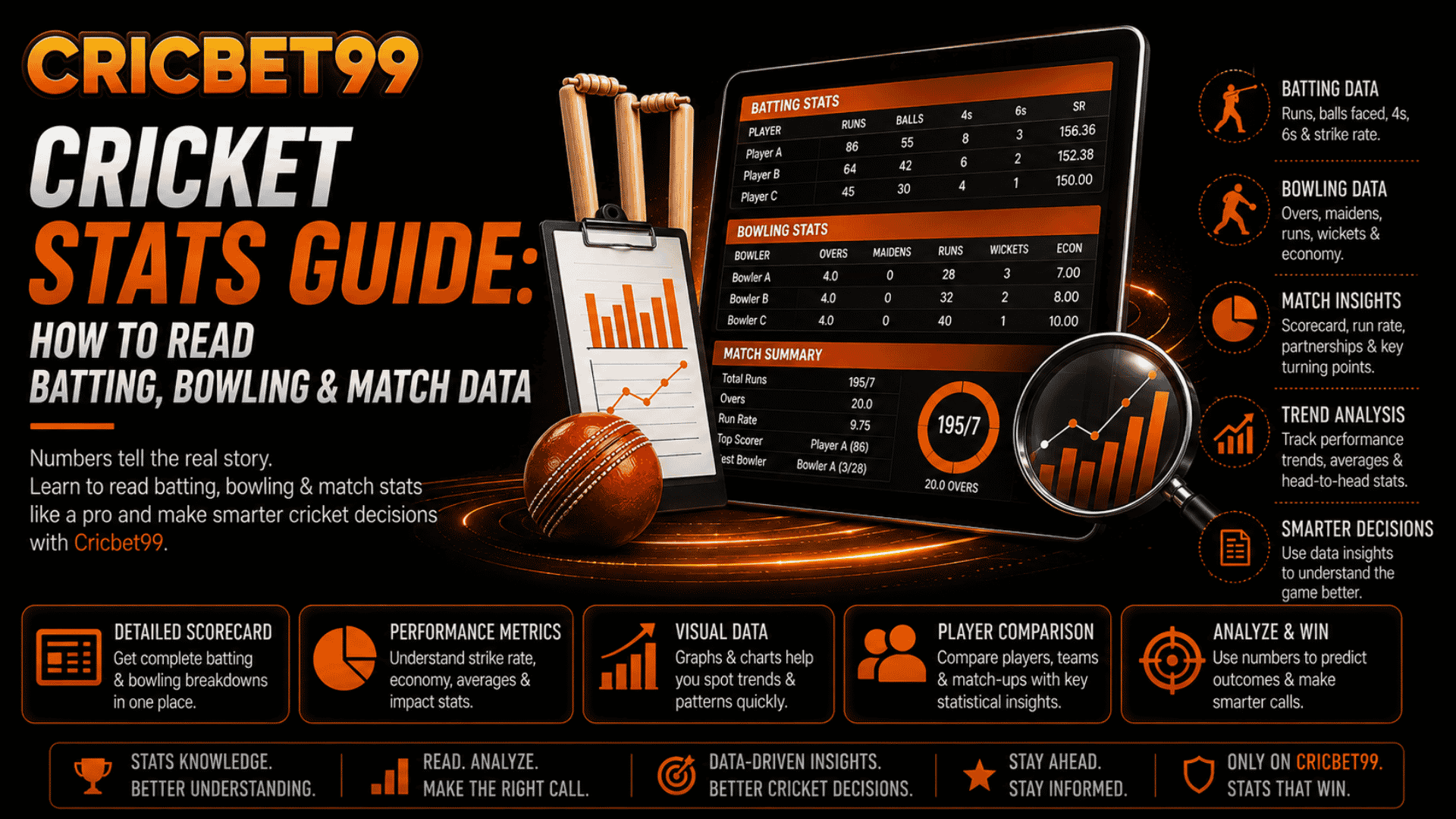
Cricbet99 Cricket Stats Guide: How to Read Batting, Bowling & Match Data
Watching a cricket match may seem easy but the numbers behind it can tell a much bigger story. Runs, wickets, strike rate, economy rate, averages, partnerships and many more figures go a long way in explaining what actually happened on the pitch.
The Cricbet99 Cricket Stats Guide is for all those who want to know about the numbers in cricket without getting into complicated terms. Whether you follow Test cricket, ODIs, T20s or IPL style matches, knowing how to read stats can make your match experience much more interesting.
Why Cricket Statistics Matter
Cricket statistics give useful context that a scoreboard may not.
Two batters can score 50 runs, but one may face 35 balls, while another faces 60. They have scored the same number of runs but made very different contributions.
The Cricket Stats Guide helps readers to look beyond the simple scores and understand what the common numbers in cricket mean.
Statistics can help you find out:
- Batters with consistency
- Good bowlers.
- Quick scoring innings
- Economical spells of bowling
- Strong Alliances
- Team Scoring Trends
Understanding Basic Batting Statistics
The Cricbet99 Cricket Stats Guide begins with an understanding of the common batting terms that appear on a scorecard.
1. Runs
Runs The number of runs a batsman scores in an innings. It’s one of the simplest statistics to grasp.
A player scoring 80 runs has contributed more runs than a player scoring 25 . But the situation of the match also matters .
2. Balls Played
Balls faced tells you how many balls a batter has faced
This is especially useful when comparing hitting approaches. E.g. 50 runs from 30 balls is a much faster rate of scoring than 50 runs from 60 balls .
3. Rate of strike
The strike rate tells us how quickly a batter scores.
The simple formula is:
Strike Rate = (Runs ÷ Balls) x 100
In limited overs cricket strike rate is particularly important as teams have a limited number of deliveries.
4. Batting Average
Batting average is usually a measure of how many runs a batter scores each time they are put out.
A higher average is often seen as consistency, but the stat should always be looked at in relation to the format and the role of the player.
How to Understand Bowling Statistics
The next part of the cricket statistics guide looks at Bowling figures.
Bowling statistics can tell you whether a bowler was successful, economical or under pressure.
Some important figures are:
- Overs bowled
- Allowed runs
- Wickets lost
- Economy fare
- Maidens Bowling avg
The bowling stats section of Cricbet99 can be very useful to compare different bowling performances.
Economy Rate
Economy rate shows how many runs a bowler concedes per over
The formula is simple: “
Economy Rate = Runs Conceded / Overs Bowled
For example, if a bowler concedes 24 runs in 4 overs, the economy rate is 6.00.
A lower economy rate usually means the bowler was successful in limiting scoring.
Wickets
Wickets is the number of times a bowler got a batsman out.
But wickets should not be considered in isolation. Even if some other bowler has taken 3 wickets, a bowler who has taken 2 wickets and given away a few runs might have bowled a very good spell.
Reading Match Data Like a Beginner
Once you have the batting and bowling figures you can then begin to look at the wider Cricbet99 Cricket Stats Guide information.
Match data may include:
- Team Stats
- Overs bowled
- Required rate of run
- Run rate
- Fall of wickets Partnerships Extras
- Innings comparison Spin Data
The match data of Cricbet99 cricket app download can provide some insight into how a game progressed through its phases.
For example, a team might score slowly for the first 10 overs and then accelerate later. The score of this game would hide an important detail.
A Step-by-Step Introduction to Reading Cricket Stats
If the statistics seem too much to handle, keep it simple. A simple process can be followed for the Cricbet99 Cricket Stats Guide.
- Check team score: Begin with total runs, wickets and overs.
- See individual batting: Who scored the most runs and how many balls did they face?
- See strike rates: This tells you something about scoring speed.
- Bowling stats review: Look at wks and runs given and economy rate.
- innings compare: Look at the scoring trends of both teams.
- Review partnerships & extras: They can explain the way in which a team reached a certain total.
This method makes it much easier to learn how to read cricket stats, especially when you are new to scorecards.
How to Compare Batters Using Statistics
To make the Cricbet99 match statistics more helpful, it is better to compare the players on a number of numbers rather than a single one.
Suppose Batter A has:
- 420 runs
- 42 average
- 138 strike rate
While Batter B has:
- 450 runs
- 36 average
- 122 strike rate
Batter B has more runs in total, but Batter A may have provided more efficiency and faster scoring, depending on the format of the match.
And that is why Cricbet99 batting stats should be viewed together not individually.
A separate page can be maintained for a trusted Cricbet99 platform India page for readers who are seeking account related information. The information content can remain clear and distinct from statistical analysis.
Understanding Cricket Stats in Match Context
Put the numbers into the context of the match situation and you get more from them.
Scoring 70 runs in a comfortable chase is different from scoring 70 runs with regular wickets falling.
Similarly, the effect of a bowler’s four-wicket haul may vary depending on whether the wickets fell off top-order batters or lower-order players.
The Cricbet99 Cricket Stats Guide encourages you to look at the context, rather than treat every statistic as a stand-alone fact.
If you are doing a separate research on account access, online information about a Cricbet99 ID online should never be mixed up with cricket statistics or match analysis.
Common Errors in Reading Cricket Data
There are a couple of common statistical interpretation errors that beginners make.
- Total runs only
- Balls faced ignored
- Head to head format comparisons of players
- Judging bowlers on wickets alone
- Disregard match conditions
- Historical numbers as a promise of future performance
The Cricbet99 Cricket Stats Guide is most useful when you think of statistics as information, not as certainty.
Cricbet99 may have a cricket app for mobile users to conveniently access cricket-related information Readers should always verify the current official information and supported features
Using Statistics Smartly: Cricbet99 Cricket Stats Guide
Cricbet99 Cricket Stats Guide is primarily to be used to understand cricket better.
Statistics can show trends, but they cannot guarantee what will happen in the next game. Cricket is affected by the pitch, the weather, team selection, injuries, the result of the toss and how the individuals perform.
For instance, if you’re researching access-related topics, separate your statistical research from Cricbet99 Login india information, and verify current information from reputable sources.
Conclusion
Cricbet99 Cricket Stats Guide breaks down cricket numbers into simple categories, making it easier to understand cricket data. Batting, Bowling, and overall match data.
Runs, wickets, overs – the basic figures are a good start. Then move to strike rate, average, economy rate, partnerships and other detailed stats.
Cricket betting id india is not a common term at all for those who are looking for cricket based services in India. It should not be confused with normal scorecard analysis.
At the end of the day, the Cricbet99 Cricket Stats Guide is about putting context to the game. A good knowledge of statistics allows you to see why a batter’s innings was important, why a bowler’s spell shifted the momentum, and how a match played out from start to finish.
Frequently Asked Questions
1. What’s the easiest cricket stat to understand?
Usually, the best place to start is with runs. Then you will be able to know wickets, overs, balls faced, strike rate and economy rate.
2. Why is strike rate important in cricket?
The strike rate shows how fast a batter scores in relation to balls faced. “It’s very useful in T20 and ODI cricket.
3. What is the Economy Rate?
Economy rate is the average of the number of runs given by a bowler per over. Lower figures generally mean tighter bowling.
4. Can you predict the outcome of a match from cricket stats?
No, statistics can provide context and detect patterns, but they can’t guarantee the outcome of a game. “Conditions and performances can change quickly.
5. How to read cricket scorecards for beginners?
Begin with the team total, wickets and overs. Then look at the individual batting stats, bowling stats, partnerships and extras. With enough practice, scorecards become more intuitive.