
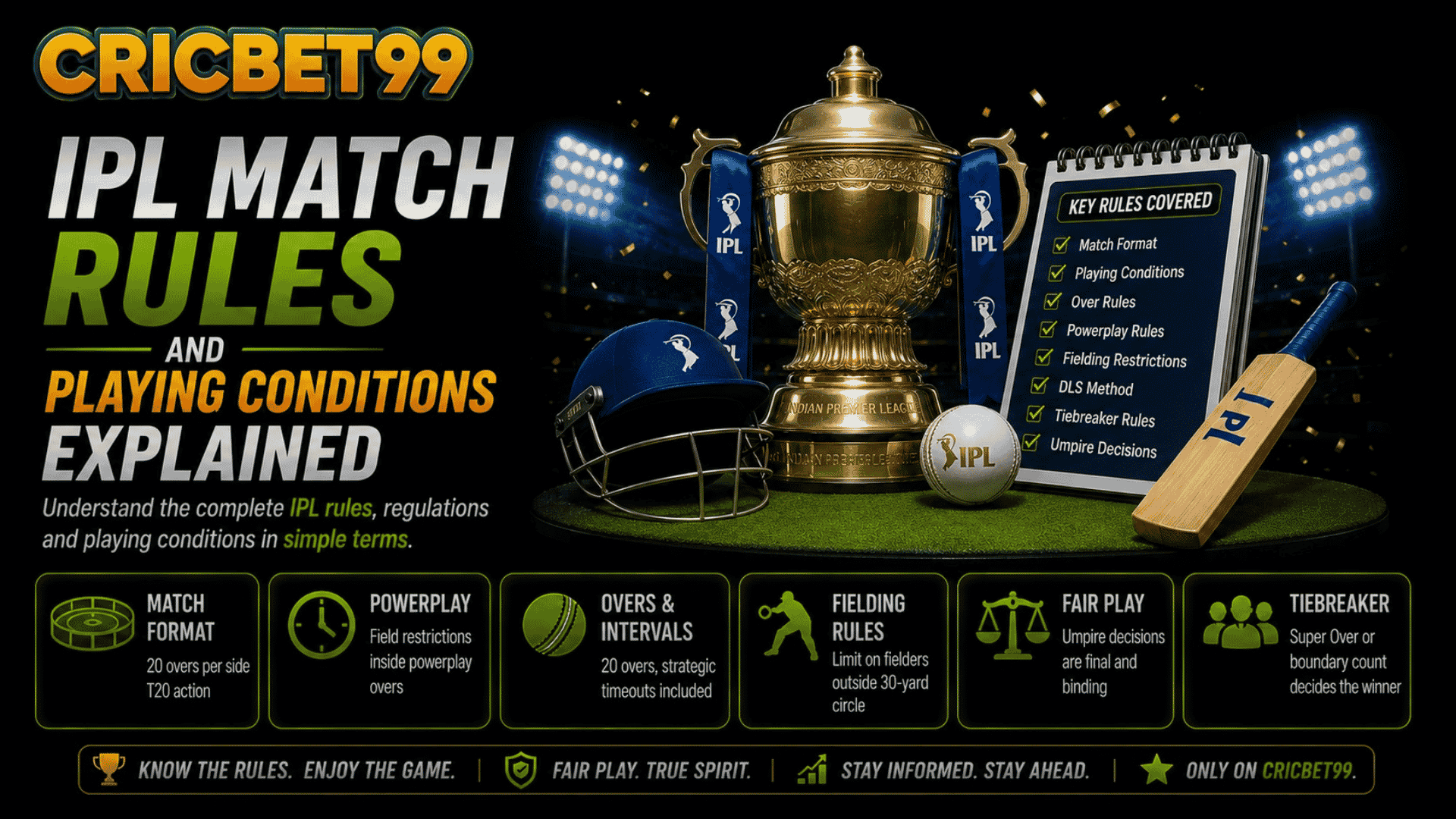
IPL Match Rules and Playing Conditions Explained
The Indian Premier League is one of the most well-known 20 Cricket Leagues across the globe. Shorter matches, exciting batting, specific bowling, and strict playing conditions make sure that each over counts. Along with the standard laws of cricket, there are certain IPL match rules that concern team compositions, player substitutions, innings duration, appeals, fielding limitations, and match results.
Having known about the Match rules of the IPL, it will become easier for people who are just learning how to watch and enjoy the game.
What Is the IPL Match Format?
IPL is played with the Twenty format, which means each team will get one innings for scoring a maximum of 20 overs in general circumstances. An innings ends earlier either if the batting side loses all its wickets or makes the required target.
According to the traditional IPL playing conditions, each team will get a maximum of 20 overs to make runs. Every six legal balls constitute an over. Generally, bowlers will get only four overs each in one complete innings of 20 overs.
The batting side that bats first sets the target, and the other side will try to chase that target within the allocated overs. If the batting side manages to make the target, then they win by wickets in hand, whereas if they fail to do so, then team with more runs wins.
These are some IPL basic rules cricket game; however, there are some other rules too.
Toss and Choice of Innings
Before the match begins, the captains meet for the toss. The victorious captain can decide whether to bat or field first for their team. There are certain IPL Match Rules which should be adhered to by all players.
These factors may be considered while making the decision of batting or bowling first.
At some venues, teams may prefer chasing because the ball can become easier to hit later in the evening.
The toss therefore forms an important part of match strategy, although it does not guarantee a winning result.
Team Composition and Playing XI
Each IPL team names a playing XI before the match. The selection must follow the competition’s squad and overseas-player regulations. Trusted Cricbet99 platform: It refers to the platform, and what type of sports and games are offered by this platform.
It is possible to form a team where there can be Indian players as well as foreign players. There are some restrictions when it comes to forming the playing eleven with foreign players.
The captain is responsible for making sure that the team adheres to the game rules in the game.
Impact Player Rule
One of the notable developments in modern IPL cricket is the Impact Player system.
This clause provides the right to a team to replace a player with another during the game, depending on the terms of the tournament. The teams reveal the substitutes who qualify before the game, and their replacement has to comply with the required rules. Cricbet99 ID online Refers to an online account or ID associated with the Cricbet99 platform.
The Impact Player can make a huge difference in tactics. A team can have an extra batter for the chase of a tough target or even another bowler for the defence of the target.
This clause plays an important role in the understanding of IPL Match Rules.
Powerplay Restrictions
The first six overs of a typical 20-over innings make up the powerplay.
During this phase, fielding restrictions restrict the number of players who can be positioned outside the prescribed inner circle area. Knowing the IPL Match Rules helps one to enjoy watching IPL cricket more. Cricbet99 apk download to details on how to download the Cricbet99 Android application file.
There will be greater chances for batters to score boundaries at the start.
There are certain fielding restrictions that change after the completion of the powerplay.
These restrictions are an integral part of the IPL rules discussed, as they have an effect on batting aggressiveness and bowler strategies. Opening batsmen try to benefit from fielding restrictions while bowlers try to prevent boundaries from being scored.
These rules for IPL matches make bowling changes very crucial.
No-Balls and Free Hits
A no-ball can occur for several reasons, including an illegal delivery or an infringement of the bowling conditions. Cricbet99 Login Refers to the process of accessing an existing Cricbet99 account.
A no-ball normally gives the batting side one additional run, and the delivery generally has to be bowled again. In limited-overs cricket, a no-ball can also result in a free hit on the following delivery, depending on the reason for the no-ball and the applicable competition rules.
During a free hit, the batter generally cannot be dismissed in the usual ways associated with a normal delivery, although certain forms of dismissal remain possible.
This rule encourages batters to attack and puts additional pressure on bowlers after an infringement.
DRS is an important part of modern IPL playing conditions because it provides another layer of decision-making when an on-field call is disputed.
How the Winner Is Decided
Winning conditions in a typical IPL game are the team with the higher score at the end of the innings for both teams, provided the chasing team has reached their target score before the end of the match.
For instance, Team A scores 180 runs, while Team B requires 181 runs to win. Team B will win by three wickets if they manage to score 181 runs with three wickets left.
However, if Team B manages to get to 170 runs after 20 overs, then Team A will have won by 10 runs.
Below are simple IPL match rules .
Understanding Fair Play and Match Conduct
Players and administrators have to adhere to the Laws of Cricket, competition regulations, and disciplinary guidelines. The IPL Match Rules also cover DRS and match outcomes. cricket betting id india A general phrase referring to online cricket betting account services in India.
Rule violations will lead to sanctions such as warnings, penalties, fines, and others.
IPL Rules Explained for New Viewers
However, if a new viewer of the IPL tries to focus on some basic aspects, he will realise that each team usually has 20 overs to play, a bowler can usually bowl four overs, there are fielding restrictions during the powerplay period, extra runs can be scored due to wides and no balls, and DRS can be utilised to examine certain decisions.
IPL cricket rules might look confusing, but observing several games helps understand the system better.
Moreover, it should be kept in mind that it is necessary to consult the official rules of the competition in the current season since playing conditions can vary depending on the particular season.
Conclusion
Knowing the IPL Match Rules will enable one to have a good time watching matches and help them keep track of decisions made on the ground. Right from the 20 overs game, powerplay, maximum number of bowlers, DRS, Impact Player rules, to Super Overs among others, all rules play an important part in making sure that the game is played fairly.
The IPL playing conditions might seem difficult at first, but when you get to know the rules, everything becomes easy. Be aware of any change of rules, since things change from one IPL season to another.
Frequently Asked Questions
1. What are the major IPL Match Rules?
There are a variety of Match Rules regarding the 20-over innings, the number of overs in an innings, the player eligibility and other issues.
2. How many overs are played in an IPL innings?
Normally, under favorable circumstances, an innings in IPL can last for up to 20 overs.
3. What are the IPL playing conditions?
IPL playing conditions are special regulations applicable only to IPL and include a variety of issues such as substitutions, reviews, fielding restrictions and rain interruptions.
4. What is the IPL powerplay?
The normal powerplay includes the first six overs where there are certain limitations on the number of fielders that are allowed outside the inner circle.
5. How many overs can one bowler bowl?
According to normal Match Rules of IPL one bowler can deliver up to four overs in a full innings.
6. What happens if an IPL match is affected by rain?
There are certain procedures for any interruptions during the IPL match, according to the IPL playing conditions. Revised target may be calculated with DLS.
7. Is it possible that the IPL match would finish with a tie?
Yes, it is possible that